How Long Does It Take to Learn Digital Marketing?
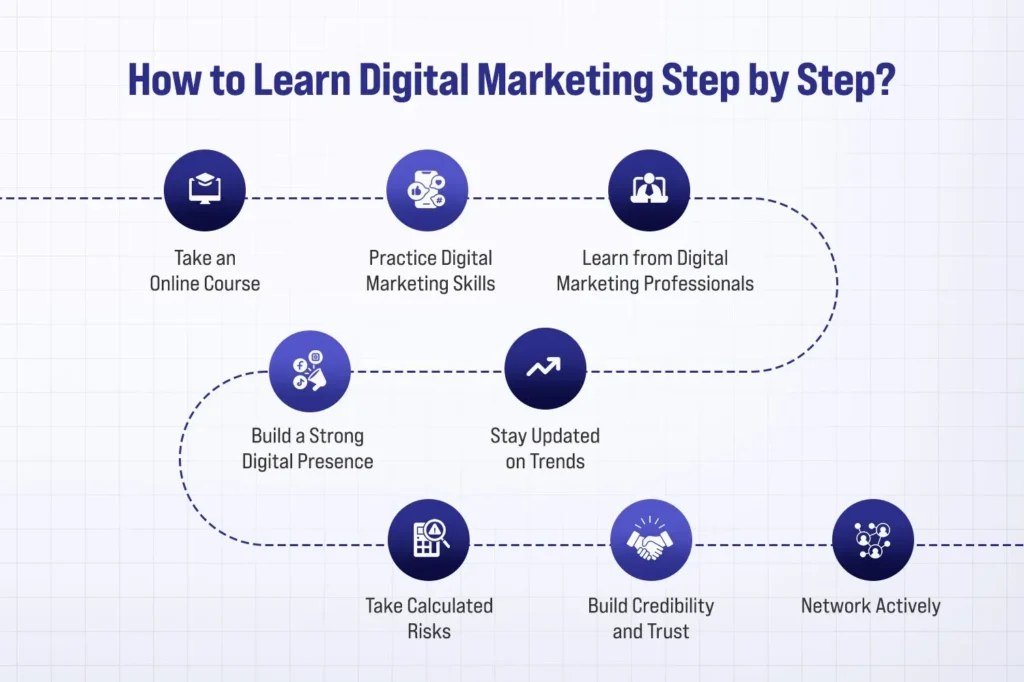
If you have ever spent an evening scrolling through job boards or Instagram, you have probably stumbled across an ad promising you can master digital marketing in just seven days. It sounds amazing, right? A quick certification, a shiny badge for your LinkedIn profile, and suddenly you are running high-budget campaigns for major brands. The reality is a bit more grounded. If you are sitting down to figure out how long this actually takes, let’s skip the marketing fluff and look at what it truly requires. You can easily grasp the core theory and fundamentals in about 1 to 3 months. But becoming genuinely job-ready, confident when a campaign fails, and skilled enough to drive real, measurable revenue? That usually takes around 6 to 12 months of rolling up your sleeves and doing the actual work. Let’s break down what your journey will actually look like, month by month, and why certain skills take longer to stick. 1. The Real Timeline: From Absolute Beginner to Confident Professional When people ask about the timeline, they want to know what their life will look like at different stages. Here is a realistic roadmap of how your brain and your skillset will evolve. Months 1 to 3 (The Confusion-to-Clarity Phase): This is where you learn the language. You will figure out what SEO actually stands for, how pixels work on websites, and why organic reach feels so elusive. By the end of this stretch, you won’t feel like an expert, but terms like “impressions,” “conversions,” and “bounce rate” will finally stop sounding like alien code. Months 3 to 6 (The Experimentation Phase): This is my favorite stage because it’s where things get fun. You stop just reading tutorials and actually start building things. You will launch your first tiny budget ad on Meta or Google, set up a tracking dashboard in Google Analytics, and maybe even play around with AI tools to help write your ad copy. You will make mistakes, like targeting the wrong audience or blowing through a small test budget, and that is entirely normal. Months 6 to 12 (Finding Your Groove): True confidence doesn’t come from passing a multiple-choice test; it comes from troubleshooting. During this window, you learn how to look at a flatlining campaign and figure out how to fix it. You start building a portfolio of real projects, and you realize you can hold your own in a marketing meeting. 2. Why Your Speed Depends on More Than Just a Course Have you ever wondered why two people can take the exact same bootcamp, but one gets hired immediately while the other struggles? It rarely comes down to raw talent. Instead, it usually boils down to three hidden factors: Your Daily Time Investment: If you are treating this like a casual hobby, dedicating just 30 minutes a week, it might take you years to catch up. But if you can carve out 3 to 4 focused hours a day, mixing video lessons with hands-on practice, you can compress that timeline significantly. Your Natural Inclination: Lean into what you already enjoy. If you love writing, storytelling, and human psychology, Search Engine Optimization (SEO) and content marketing will feel like second nature. If you are more analytical, enjoy staring at spreadsheets, and love tracking numbers, performance marketing (paid ads) will click much faster. Your Learning Environment: Watching prerecorded video lectures in isolation is a slow path. True acceleration happens when you work on live projects. Whether that means joining a structured digital marketing course with placement support or simply building a mock website for a local coffee shop to test your strategies, active application beats passive watching every single time. 3. Breaking Down the Specializations Trying to master every single branch of digital marketing all at once is a fast track to severe burnout. Different tracks have completely different learning curves: Social Media & Content Marketing: The basics take about a month to pick up, but building a brand voice, understanding shifting platform algorithms, and keeping an audience engaged over the long haul takes roughly 4 to 6 months of daily consistency. SEO and Organic Growth: This is the ultimate test of patience. Because search engines take time to crawl, index, and trust a website, you will need to spend 4 to 6 months just learning the mechanics of technical and on-page optimization, let alone seeing your results climb the rankings. Paid Ads (Performance Marketing): Setting up a campaign dashboard takes an afternoon. However, mastering audience segmentation, bid strategies, and optimizing your return on ad spend (ROAS) requires 6 to 9 months of active campaign management and budget tweaking. Bringing It All Together At the end of the day, a certification is just a piece of paper. The real power comes from the portfolio you build along the way. Don’t wait until you feel “100% ready” to start doing the work—because in digital marketing, things change so fast that nobody ever feels completely ready. Launch a personal blog, run a micro-budget campaign for a passion project, or offer to manage social media for a local nonprofit. That real-world friction is where the true learning happens.